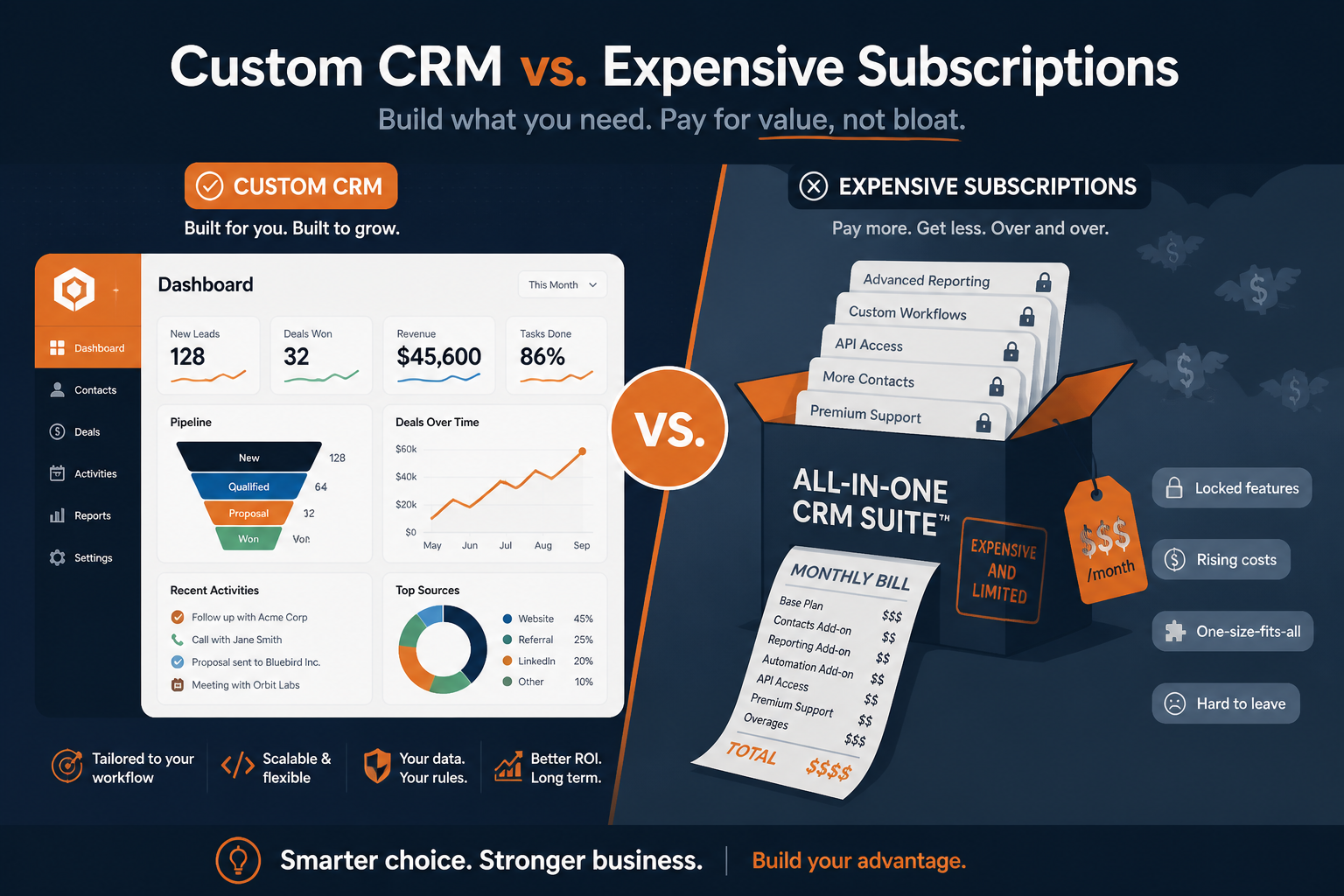
Salesforce is the most powerful CRM on the market. It is also the wrong tool for almost every small business. The mismatch between what Salesforce was built for (giant enterprise sales organizations) and what a small business actually needs is enormous, and you pay for that mismatch every month.
Here is the real math.
The headline price is not the price
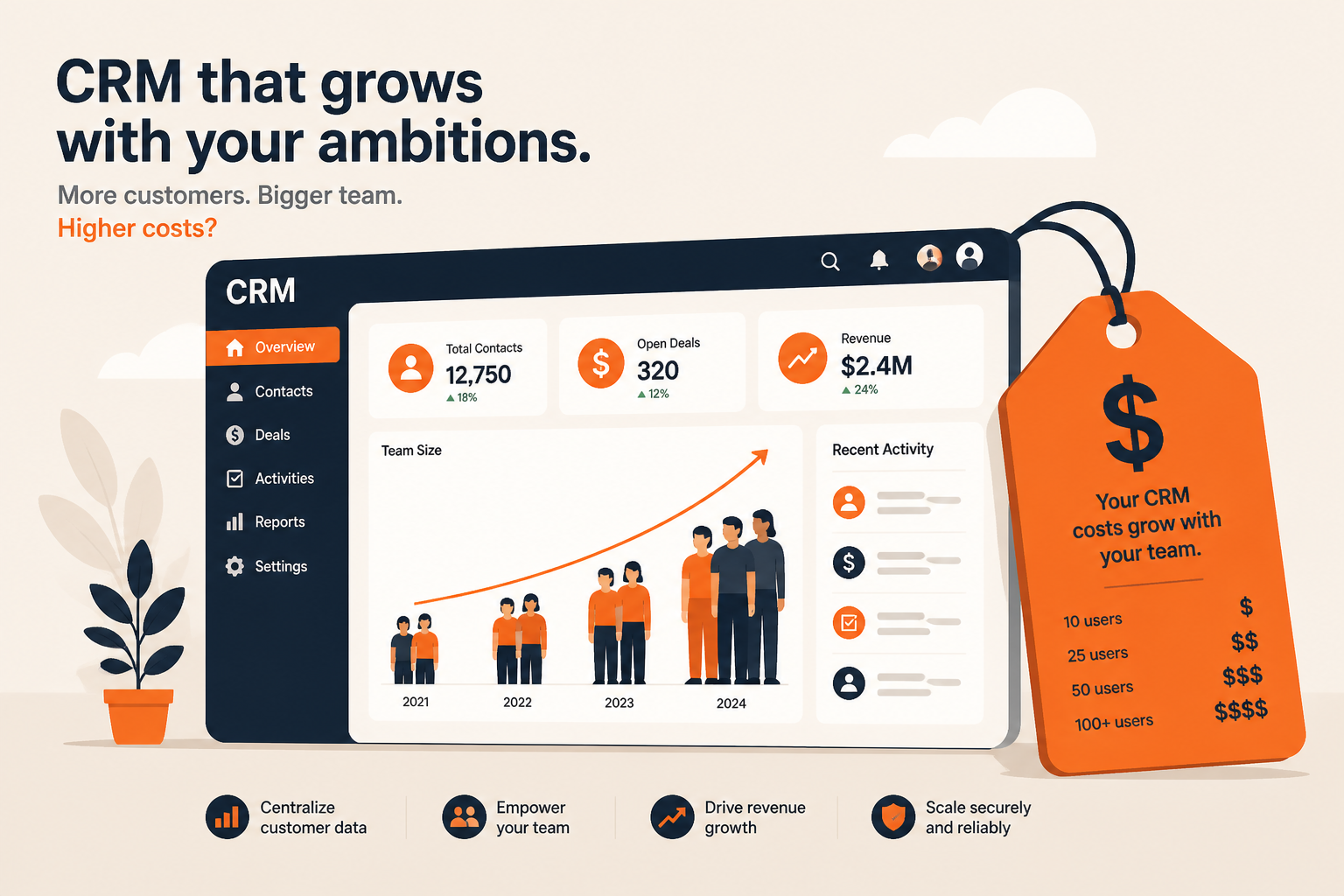
Salesforce Sales Cloud lists at $25 per user for Starter, $80 for Professional, $165 for Enterprise, and $330 for Unlimited. That looks reasonable until you realize three things:
- Anyone serious about Salesforce is on Enterprise or higher. Professional cannot run real workflows.
- Almost nobody implements Salesforce themselves. The implementation partner is usually $10,000 to $50,000.
- Salesforce charges extra for almost everything, Pardot for marketing, CPQ for quoting, sandboxes for testing, additional data storage, API call volume above a low default cap.
A 10-person small business on Salesforce Enterprise, after implementation, after the add-ons most teams need, is usually paying $30,000 to $60,000 in year one and $20,000 to $40,000 every year after.
What you are actually using
Walk into any small-business Salesforce instance and the usage looks like this:
- Contacts.
- Accounts.
- Opportunities and a pipeline.
- A few reports.
- Maybe a workflow rule or two.
That is roughly 5 percent of what Salesforce can do. You are paying for the rest in case you ever need it.
The hidden costs
The Salesforce bill on your invoice is only half the story. The other half:
- An admin (full or part time) to keep it running. $40,000 to $90,000 a year.
- A consultant for every non-trivial change. $150 to $300 per hour.
- Time wasted by your team navigating a complex UI built for enterprise.
Add it up and the true total cost of ownership for a 10-person team is often $60,000 to $120,000 a year.
Why Salesforce is hard to leave
This is by design. Once your data, your workflows, your reports, and your team training are all inside Salesforce, the switching cost feels enormous. That is the moat.
Here is the good news: that moat is mostly emotional. Data exports are easy. The actual logic, pipeline stages, fields, reports, is usually a few dozen rules that any modern stack can replicate.
The custom-build alternative
A custom CRM that does what your small business actually does, contacts, companies, deals, pipelines, email sync, reporting, simple automation, is a $12,000 to $20,000 build with $30 to $80 per month in hosting.
For a 10-person team paying Salesforce $30,000 a year, you break even in under a year. Year 2 onward, you keep $29,000+ per year.
For a 25-person team paying Salesforce $80,000 a year, you break even in about 3 months.
"But our sales team knows Salesforce"
True. And they will know your custom CRM in a week, because it will only do the things they actually use. A small focused tool is much easier to learn than a sprawling enterprise platform.
"But what about reporting?"
Modern dashboards (built with the same charting libraries Salesforce uses) take a day or two to put together. You can replicate every report you actually look at, and skip the ones you do not.
Bottom line
Salesforce is the right call when you have a 100-person sales team, complex deal structures, and a dedicated admin. For a small business, it is a tax. Run your numbers through our calculator to see what your real Salesforce cost is, and what owning a CRM would look like instead.